Tuesday, September 27, 2016

Confronting the Archive: Seven Questions


C:\Users\peter\Pictures\Chicago\PICT1148.JPG

(Conference paper delivered at Univ. of Pittsburgh, March 2016.  Many of the illustrations are well-known already; some I have used in other presentations.  Together here, I hope to illustrate my comments on the functions of archives.)

A key distinction needed for my argument is not always made by students of literature today.  It distinguishes works (which are verbal mind constructs created in acts of reading) from books (which are material objects created by authors, publishers, and printers). Literary critics confront literary works (verbal mind abstractions) by looking through the printed page.  Textual critics confront archival books (textual material objects) by looking at the printed page.  The physical copy of the book, which the critic holds, represents the literary work, verbal art, created in the reader's mind as a reading experience.  It is interesting to note that the book the critic holds is just a copy; it is not the original nor "the thing itself".  It might be interesting to ask, "From which previous copy was the present copy copied?"   That is different from asking, "Of what is my copy a copy?"  

77373http://www.nupress.northwestern.edu/sites/default/files/covers/0-8101-0269-2/moby-dick-or-the-whale.jpeg
      If I hold the Norton Critical Edition of Moby-Dick edited by Hayford and Parker, the answer to the first question (what was my copy copied from?) would be "It is a slightly altered copy of the Northwestern-Newberry Edition, edited by Hayford, Parker, and Tanselle, which itself was copied eclectically from a combination of  [Slide] the first American and first British editions, with additional editorial emendations thrown in."  

The answer to the second question (what is my Norton Critical Edition a copy of?) would be, "This is a copy of the novel Moby-Dick by Herman Melville." (I'm sorry, there is no image of the novel itself , whatever that is when it is experienced in the minds of readers.)  It is rather important to distinguish, therefore, the work as a verbal art experienced in reading from its representation in any given physical copy.  This distinction is subtle and problematic when one observes that the manuscript of Moby-Dick was (it no longer exists)--was just the first copy of the work.  What are we to do with the facts that, first, every copy of the work differs from every other copy? and, second, no copy of the work is the work itself? and, third, every copy of the work represents the work in some sense?  The first step in sorting out this tangle is, I think, to say that a literary work is a cognitive construct, a mental construct or abstraction created by reading, while the book is a physical object.  The science/ art of exploring the relationship between the physical book and the verbal work is called textual criticism.  Literary critics who prefer soft swampy fields of play or foundations in shifting sand do well to avoid textual criticism.
There is a sense, however, in which we are all both literary and textual critics, and we are best when we are both.  The more I know about each field the more their supporting evidence, methods, and goals invade each other's territory.  I've come to think that separating literary from textual criticism is murdering to dissect.  Yet, it is common for critics and students to treat the copy in hand as if it were the work, untroubled by the evidence from the archive.    
What are the questions that literary / textual critics can ask when confronted by the archive.  (Wouldn't it be nice if  the archive came to us and confronted us?)  I have made a list of seven questions from FAQs to SAQs (Frequently asked to Seldom asked).  As for which questions are the most important or the most interesting--each of us is likely to choose a different order for the list.    
Probably the most frequently asked question when confronted by the fact that early copies of a work (indeed all copies) differ in wording and punctuation is:
1.  Which is correct?   The assumption is that one reading is the correct one and all the rest are errors.   Sometimes this is so.  This question reflects a simple desire:  Give me the right text please, and don't bother me with the boring details of textual comma counting.  Of course, sometimes nobody knows which is right or which is wrong.  Fredson Bowers called these situations "indifferent"  not because he did not care but in allusion to the center of indifference--that point between the poles of a magnet where the pull in each direction is equal.  Nevertheless, errors have been made and some can be identified.  We divide them into innocent and sophisticated errors.  An innocent error is an inadvertent error which usually strikes the reader as an error and can usually be fixed in one's mind while reading.  We often call them typos.  It is surprising how easily readers auto-correct innocent errors.  
Aoccdrnig to a rscheearch at Cmabrigde Uinervtisy, it deosn't mttaer in waht oredr the ltteers in a wrod are, the olny iprmoetnt tihng is taht the frist and lsat ltteer be at the rghit pclae. The rset can be a toatl mses and you can sitll raed it wouthit porbelm. Tihs is bcuseae the huamn mnid deos not raed ervey lteter by istlef, but the wrod as a wlohe.
Sophisticated errors, by contrast, create readings that are real words.   Sometimes, like an innocent mistake, the error is obvious but the correction is not. An example comes from William Thackeray's Vanity Fair. At the sale of the bankrupt Sedley household, the auctioneer offers for sale the picture Becky Sharp had drawn of Jos Sedley riding an elephant.
E:\Loyola\Grants\Woolf\Images\Jos.jpg
William Dobbin, remembering the occasion of the drawing, reacts in a way that the auctioneer takes to be a bid. Dobbin immediately blushes and looks confused, at which the text says, "the auctioneer repeated his discomposure."  No critic is on record with a successful interpretation of "the auctioneer repeated his discomposure."   It is obviously an error.  But the manuscript has disappeared, there is no surviving proof page, and so the only record of what Thackeray meant to write is in this botched physical survivor.  We want a correct text but we can't have one.  We can guess that the auctioneer respected his discomposure, which would be a bit odd, given Thackeray's own drawing of the scene, but at least "respected" makes sense.  Nobody claims that it is correct.
Unfortunately sophisticated errors do not always strike the reader as an error; they are plausible, sensible, and therefore invisible or even attractive.  I won't mention the wicked Bible in which we are commanded to commit adultery--though most editors insist that the word NOT was inadvertently left out.  Another example of a sophisticated error is the change in Herman Melville's White Jacket (1850) where the sailor, having fallen overboard and sunk into the sea has just about given up the will to live when a "coiled" fish of the sea brushes against him, reviving him with fear and love of life.
brushed by a coiled fish of the sea   1850
                        soiled                       1922
Melville died in 1891
A compositor for the Constable edition of 1922, mistakenly set "soiled" instead of "coiled", which not only made plausible sense, but led F. O. Matthiessen to exclaim that the metaphorical resonances among the soiled white jacket, the sailor's soiled soul, and the sea's soiled fish could hardly have been produced by anyone but Melville.  It wasn't.  Matthiessen didn't know he had mistaken an error in the Constable edition for a bon mot; but some other critics have opined that if Melville did not write "soiled" he should have.  So, perhaps after all we don't care if we have a correct text.
Which leads to the second question a literary critic can ask of the archive:
2.  When was the textual variant introduced?  This might be a variation of the first question--an attempt to determine  which reading was first or older and therefore perhaps the most authentic one.  If, however, we are looking for progression in the author's thinking or revision or adaptation for new audiences, we are beginning to seek facts about the textual history and potentially interesting explanations for textual difference instead of just dismissing that which we consider wrong. In the case of White Jacket, Melville died in 1891 and "soiled" made its first appearance in 1922, created by a compositor who had sophisticated the text--purposely or not.  
The third question may be yet another variation of the first two questions, asked in an attempt to determine the correct text so we can ignore all the incorrect ones--unless they appear to be attractive sophistications.
3.  Who made the change?  The likely suspects include the author, the secretary, the publisher's copy-editor, the compositor, a censor, someone from the marketing department  hoping for more sensation, or someone from the liability department hoping for less.  If we can pin the textual change on one of these suspects, will we then be able to value one reading over the other?  Are we still stuck in the first question, trying to find out which text is the one and only one we have to deal with and which ones we should avoid--now, perhaps not because they are incorrect, but because they are "less authentic"?  Or, perhaps better, are we now asking interesting questions about the voices in the text and the effects of who said what?
In the case of White Jacket, it is difficult to argue that the 1922 compositor had the "authority" to introduce changes, though, of course, he had the power.  [Slide]What about the case of Shakespeare's Hamlet in which Hamlet laments either his "too sullied flesh" (Q1 1603), his "too sallied flesh" (Q2 1604), or his "too solid flesh" (Folio 1623).  Who did it is hard to say, for though Shakespeare was alive for Q1 and Q2, he is not known to have had anything to do with those publications, and he was dead by the Folio.  And yet, might the copies the editors of the folio used have been seen by Shakespeare?  We do not know.
What about an aspect of the book that is not textual but is significant?  Lord Byron's Don Juan was first published in a large, expensive edition[Slide] with large margins and elegant type.
http://pictures.abebooks.com/RYANOHORNE/15477157102.jpghttps://www.withfriendship.com/images/g/30157/Don_Juan_(Byron)-picture.jpg
Childe Harold’s Pilgrimage. Canto the third. London: John Murray, 1816, pages 12-13. KCL Rare Books Collection PR 4372.F2.
 It was, therefore, literary art--although the publisher, John Murray, did not identify his publishing house on the title page or anywhere else in the book.  But the millions of copies of pirated editions that followed almost immediately were small things, on cheap paper, at cheap prices.   
http://pictures.abebooks.com/TIMOTHYLOE/16478412817.jpghttp://pictures.abebooks.com/WORLDOFRAREBOOKS/16217124021.jpg
Were they, therefore, soft porn instead of high art?  Who did it?  In both cases, the decisions about format, and therefore the impact that the material presence had on readers, was more likely to have been made by a publisher than an author.  Should the question be "Which is the correct form?" or should it be "What impact does a book's physical form have on a reader's creation of the literary work, the verbal mind object, represented by the book?"
Or take the case of two poems by the Tasmanian poet Gwen Harwood, ``Eloisa to Abelard" and ``Abelard to Eloisa,"  under the pseudonym Walter Lehmann, published in and then immediately suppressed by The Bulletin (a Sydney literary magazine).

Several years ago an Australian friend gave me a photocopy of these poems and told the following story: the author had already published under the same male pseudonym in The Bulletin and had written a bitter complaint to the editor that her poems were distorted in publication by having all lines pushed over flush left, destroying, thereby, significant levels of indentation.  The editor replied that the magazine's column format influenced the policy, which was applied indiscriminately to all Bulletin poetry.  According to my informant,  Harwood then wrote and submitted the two poems reproduced here.  She submitted them, it was said, with varying degrees of indentation, and the editors predictably and indiscriminately ``suppressed" the author's intentions by printing all lines flush left---creating, thereby, the ``inadvertent" acrostic message, readable vertically down the left column: `` Fuck all editors.  So long Bulletin."   From that story I concluded that it is important to ask "Who did this?"
Facsimile of The Bulletin, 5 August 1961, p. 33.
  I subsequently found that no one, including the author, Gwen Harwood, remembers the sequence of events in the way I have described them.  In fact, no one has the same story to tell.  Another Australian acquaintance actually asked Ms Harwood if the account I have given here was true, and she denied it, albeit forty years after the fact.  Regardless of the accuracy of the explanations for the physical poems,  my point is that a sense of agency (whether the historically correct one or not) is a determining factor in every reader's interpretation of the text.  
The questions prompted by the first, probably erroneous, tale remain the important ones:  Whose intentions are fulfilled?  Is this the social contract at work?  Has cultural materialism expressed the mind of society?  Has language spoken the author?  Every interpretation of the poems implies or states answers to these questions.  A biographer's, a literary critic's, and an editor's question's all converge:  is this an innocent pair of poems with a structural element of  bad taste and bitter recrimination? or are there other interpretive matters at work here?  When Eloisa says to Abelard ``Solace and hope depart" is that the author's explanation for her decision to say So Long to the Bulletin?  When Eloisa calls Abelard ``the faint ghost of a remembered dream" and concludes that she ``reap[s] the harvest of my own desire," is the author really referring to this act of bibliographical revenge?  Is the final line a warning to the editors of the Bulletin that ``No heart escapes the torment of its choice"---in this case the choice to ram all lines flush left?  These examples demonstrate that we frequently take poems, and probably novels and short stories and plays, to be hermetically sealed art objects, isolated from their context of origination, perhaps because we do not have enough training in confronting and reading the clues in the archive.

4.  Why was the change made?  Of course, it will help in determining why a change was made if we know who did it, but that is not always necessary.  Corrections in  spelling, punctuation, and grammar are sometimes thought to have self-evident motivations.  That works okay unless on is reading or editing  Finnegans Wake, or The Sound and the Fury, and such.  But when one perfectly good word is changed to another perfectly good word, or when one sentence or phrase is dropped from or added to the text, the critic in us, one hopes, starts by searching for answers.  If we don't know who made the change, when it was made, or why it was made, we might be tempted to make up explanations that pass a plausibility test, not a test verified by the archive.  Given the archive, we are not always thrown upon the resources of our own imaginations to answer the question: Why was the change made?  
     For example, in Thackeray’s The History of Henry Esmond (1852) there is a scene near the end of volume one of this “three-decker novel” depicting Henry coming home on holiday from the university and being greeted with joy by his foster mother, Rachel Esmond, and her two children, all of whom soon troop up to see Henry’s room, freshly gotten up by Rachel. In every edition from 1852 to 1989, we read that Henry and Rachel go up “hand in hand.” The phrase is not unusual, but Rachel is in a difficult marriage; Henry is only a few years younger than his foster mother; she soon becomes a widow; and in volume three, they marry. So, a careful reader might be justified in seeing this hand-holding as an early indication of things to come. In the manuscript that served as setting copy, however, the first word in the phrase “hand in hand” is squeezed in, almost illegibly, at the margin and in fact says “hat”—Henry goes up “hat in hand.” As a significant phrase about the relationship between Rachel and Henry, “hand in hand” comes far too early and the material evidence of the extant manuscript points strongly to the conclusion that the compositor created an adventitious reading—or let’s just say it: an error.  That is to say, the reason the change was made is that the compositor did not have time to decipher a cramped word squeezed into a tight corner and instead set the first thing that came to mind as a potential reading.  Needless to say, he got away with it for well over a century.
    On the other hand, in Thackeray's Vanity Fair, the surviving manuscript says of Becky Sharp that "Ill-natured persons say that her birth preceded the lawful celebration of her excellent parents' marriage."  This hand-written indication that Becky is, what at the time would have been thought of as a natural born bastard, not just a self-made one, is deleted and replaced by the comment: "And it was curious to note how as time passed this young lady’s ancestors advanced in rank and splendour"—a comment referring to Becky's ability to enhance her past as needed.   There is little question about who made the change (Thackeray) or when it was made (during proofreading); and the reason for the change is not a wild speculation, just a mild one--that it is a case of self-censorship, appropriate for a mid-Victorian mainstream novel. I think, however, we are happy to know what Thackeray's first thought about Becky was.

5.  What do I do if both (or all three or four) variants make sense and I cannot pin any of them on a nefarious interloper?  Here, on a grand scale, we have an "indifferent variant"--one where our search for evidence leaves us with an unguided choice.  A E Housman describes the situation memorably of the reader/editor caught between two equally attractive textual possibilities by comparing him to an ass equidistant from two bales of hay.  Such critics think, Housman said, that by arbitrarily choosing one hay bale or variant over the other their ears will get shorter.
     Emily Dickinson's F1460A is an untitled poem [Slide] which illustrates her way of trying alternative words without, in the end, choosing a "correct" version.   One could be frustrated by such an indecisive poet, as if she couldn't finish.  Or one could learn to read as she wrote.  We could perhaps read her poem as if it were a bit richer than conventional poems.
     We can explore together.
A chilly peace infests the Grass  
maybe that does not quite get it right, so let's try
A lonesome peace infests the Grass
and then let's try
A warming peace  
These three alternative forms are not resolved.  Let us revel in all three without actually making the poem longer; it is either a chilly Peace, a lonesome Peace, or a warming Peace or a bit of all three.  One's mind can easily grasp the suggestive complexity.
The Sun respectful lies -- Not any Trance of Industry
These shadow scrutinize--
Or is it: The shadows?   Why, having written These Shadows did ED think that The shadows might be closer to the mark?  or is it?  She does not say.  But we sense the difference between These and The and the ambivalence that distinguishes the specificity or generality of shadows.
Whose Allies go no more astray
or wait, perhaps astray is a bit strong, let's try Whose Allies go no more abroad
For service or for Glee --
But wait again, perhaps not for service, perhaps for Honor, or wait again, perhaps for welcome.
Is it astray or abroad?  Is it for service, honor or welcome -- which is the best or most evocative or most appropriate contrasting alternative to Glee?
But all mankind deliver here from whatsoever Sea
Or should that be Though all mankind deliver here?
No, perhaps mankind cruise softly here from whatsoever Sea--
Or once again, perhaps they row softly or sail softly
or finally perhaps mankind do anchor here from whatsoever Sea.
I do not see any mistakes.  I see no errors.  I see variant readings that each have or had an appeal to the author.  The temptation for many editors has been to do the choosing for ED and end up with one continuous text to be read linearly.  My point here is that the choices are indifferent--held motionless between the poles of the magnet, pulled equally by the surviving evidence.  Any choice made by any editor will be arbitrary--based on personal predilection, not on archival evidence.  The choice will have no shortening effect on the editor's ears; but it will shorten and impoverish the poem for readers.
Before moving to the sixth question to ask the archive, can we just let go of the notion that there is always a correct or even a preferable text that is the one we wish to represent the work, world without end, amen.  You do not need to let go of the notion that some texts are wrong.  Some texts are wrong.  Many texts are wrong.  But it does not follow that one text is right or even that, with enough diligence we can create one text that will be the right one.  Error we abhor, so, off with its head--that is, if you are sure it is an error--or that it is not an interesting and useful error.  But, can we just learn to live with viable alternative texts and ask some decent questions when we confront the archive?  Can we not, in full textual awareness, just say which text of the work am I talking about? and also say, here are some reasons I've chosen to talk about this text rather than that other one? or even to say, actually I want to talk about both or several texts and show how knowledge of the alternative texts has helped me as a critic. These seem to me better than pretending that there is one correct text, the well-wrought urn.

6.  What effect on my reading is had by each viable alternative text?  This question is similar to but crucially different from the question: What motivated this change in the first place? --which is a question about authorial intention, to which you do not have access.  But the question you can answer, both accurately and in a variety of ways, is: What effect on my reading is had by each viable alternative text?  Perhaps it will coincide with what motivated the author, perhaps not.  Perhaps you will contemplate the effect, not of each reading in turn, but of each reading held in tension against its alternative.   In any case, it will have caused you to think deeply about a passage of text which had also troubled the author.
The poem we've just looked at, to illustrate the situation when we have alternatives that all make sense, also illustrates the richness of seeing alternatives.  Read in a way that holds the alternatives as pending choices can make the poem speak more eloquently in their ambivalence than any one of them would have spoken in marble-smooth singularity.  I do not think I want a correct text of this poem.  I think rather that this complex dialogue between author and paper is very clearly written already--correct in its multiple ambiguities.
7.  If I scrutinize each variant, including errors and nefarious interferences, and if I try to see where some of the work's locutions came from, as in allusions to, or phrases quoted (or misquoted) from other sources, and if I try to trace the genetic progression of the text, would I be able to see an authors mind a work? would I be able to see the birth and growth of a work? would I be able to watch as trial passages were replaced by new efforts?  would I be able to participate both intellectually and emotionally in the momentum of creation? might I also get the sense that when the archive gives out, and the librarian says there are no further forms of this work to look at, might I feel that the author has abandoned, rather than finished, the work--all the copies amounting to a series of efforts pursued until exhaustion or distraction interfered?   What then would you say to the critic who just wanted the correct text and please do not bother me with the details?
    Of course, authors do not always hold choices pending and unresolved.  They cancel (that is, they reject unequivocally) manuscript passages short and long for many reasons.  Were they errors? were they less felicitous locutions? did the author change her mind?  did a new creative surge wash out a previously interesting but perhaps less interesting effort?  How can we answer such questions without seeing the archive as a rich resource for critical thinking on our part and not just as a way to resolve textual cruxes?  And if the author on a death bed requests that manuscripts be burned, are we willing to comply?  Or do we register the request and hold it as one of the lights by which we examine the manuscripts?
    The scholar for whom the chair in Textual Studies I held at Loyola University Chicago gives us a brief example of how an author's mind mulls a word over time.  Of the changes Martin J. Svaglic traced in the textual history of John Henry Cardinal Newman's Apologia Pro Vita Sua, perhaps the smallest and most interesting is the triad of variants revealing Newman's developing attempt to make the doctrine of eternal punishment seem less terrible.
In 1864 he wrote that the doctrine could be "less terrible to the 'reason'"; the next year he changed it to "less terrible to the 'intellect'"; and, finally, in 1886 he wrote, "less terrible to the 'imagination.'"  None of these readings is incorrect; each was the word Newman chose for each publication.  If one tries to trace the possible motives for these changes or, with more confidence, the differences they make upon our understanding of what part of our being engages with a doctrine of eternal punishment (reason, intellect, or imagination), it should be much clearer why an interest in textual histories is not focused primarily or only on which is the correct text.
    For a far more detailed and convincing example, I will just refer you to a new book about to be published call How Borges Wrote by Daniel Balderston.  There is a huge problem with confronting the Borges archive.  His manuscripts are scattered to the winds and found in bits and pieces here and there.  Daniel has spent forty years on what is a bit like a global Easter Egg hunt and has created a surrogate archive of Borges manuscripts, complete with hovering guidance helping readers look at the myriad photos he has produced.  He has exposed so much richness there that other books could / should be written to tease out the joys of his archiving work.    
Confronting the archive is not boring or trivial; it is not just a duty or responsibility; it is not just for the bibliographers, collectors, and textual critics; it is exciting and critically rewarding--for those who have eyes to see and at least seven questions to ask.  If you doubt that, take a look at
Dirk Van Hulle ,Manuscript Genetics, Joyce's Know-How, Beckett's Nohow . University Press of Florida, 2008.
Daniel Balderston.  How Borges Wrote. University of Virginia Press.  Forthcoming, 2017.
Paul Eggert.  Biography of a Book: Henry Lawson's While the Billy Boils. Penn State Univ. Press, 2013.
Luca Crispi. Joyce's Creative Process and the Construction of Characters in Ulysses: Becoming the Blooms.  Oxford Univ. Press, 2015.

Wednesday, August 31, 2016

Photoquotes

Photoquotes
Def:    A quotation that is not transcribed but, rather, photographed and embedded in the flow of prose where normally a block quotation or quotation marks would be used.  A photoquote is not an illustration of what the scholar is referring to. It is not even just supporting evidence.  It becomes an integral part of the argument.
Quotation is a fundamental tool of historical and literary scholarship--and it is tricky. Anyone who has vetted a manuscript, be it an essay assignment in school or an article or book manuscript, or anyone who, in reviewing a book, has checked the quotations against the originals, knows how easy it is to find typographical errors.  But more important, it is easy to find cases where the quotation is not from the alleged source, but rather from some knockoff reprint.  It is also easy to identify cases where the quotation was truncated strategically or taken out of context.  
Photoquotes make such errors and deceptions more difficult if not impossible.  Scholars in search of facts and sound argument would welcome that difficulty.
Perhaps the first remarkable use of photoquotes was in descriptive bibliography when the quasi-facsimile transcription of title pages gave way to photographic reproductions.  The quasi-facsimile transcription was an attempt to reproduce with codes, symbols, and strategic deployment of white space the salient characteristics of a title page in order to give users of the descriptive bibliography a way of identifying copies of a book.  The title-page photograph not only gave a more detailed rendering of the original, it eliminated the human error virtually inevitable in transcriptions.
Skepticism and a will to believe form a basic tension in scholarship.  Scholars always want to know where information comes from.  Footnotes and lists of works cited do not just witness the range of a scholar's frame of reference, they do not just bolster the arguments with an array of authorities.  They are primarily the identification of the sources of one's information.  And yet, the most scrupulous attention to annotation only gives readers a place to go and check the accuracy and fairness of one's use of sources.  Scholarship's report about where information comes from does not change the fact that quotations and reports of information are, to the reader, hearsay--reports at second hand.
Thomas Paine explained his reluctance to believe in God and an afterlife on the grounds that he had no first hand evidence.   He said he did not deny the possibility of revelation; he only denied ever having had a revelation himself.  He did not deny that other people might have had a revelation from God; but him, when these revelations were reported, it was second hand.  He wanted evidence.  Presumably he was interested and would have welcomed evidence of God and the afterlife.  He was not stubborn; just skeptical.  He would not bank his life on secondhand information.    That is perhaps extreme if applied to all knowledge.  But scholarship is about identifying and evaluating sources and replicating arguments.   Accepting on faith what one reads is not scholarship.
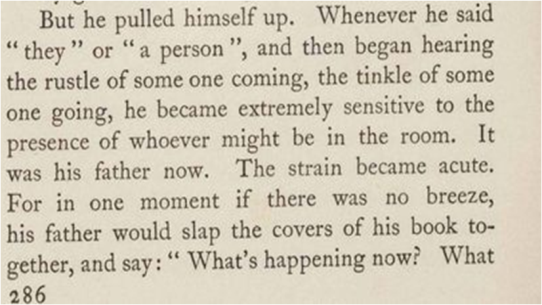
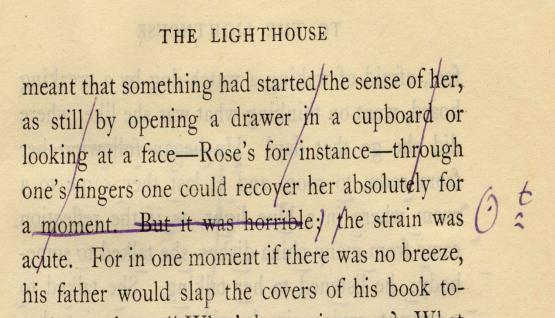
Photoquotation may be susceptible to manipulation, but a photo taken from a properly identified source document, with sufficient inclusion of margins and context would give readers a sense of authenticity far more convincing than a mere footnote to a block quotation.   For example, the following is taken from an essay on the composition and publication of Virginia Woolf's To the Lighthouse.  Imagine it with transcribed block quotations, rather than photoquotes.

Readers familiar with To the Lighthouse might be reading the following passages for the first time, since they appear in very few places--and not in any trade edition of the novel.  The question before us is, Do the cut passages add to or change one’s notion of James and his relation to his father?  All the cut passages are in the mind of James, who does not elsewhere in the novel think or express these thoughts.  In the text as it was published on both sides of the Atlantic, James thinks about his father’s nearing presence.
Fig. 2  (p 286 British Edition)
(Grateful acknowledgement is made to The Society of Authors as the Literary
Representative of the Estate of Virginia Woolf for permission to photo-quote
from Woolf's original documents.)

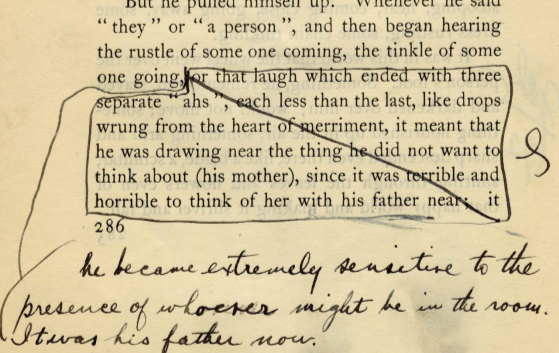
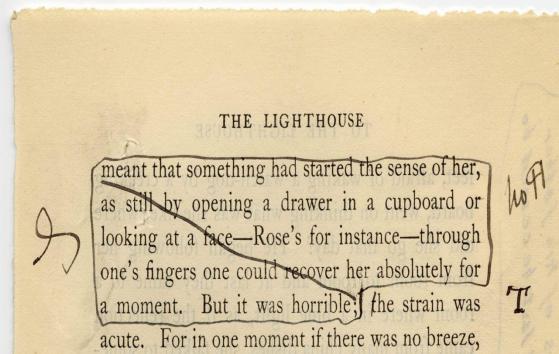
Originally, the proof-version that Woolf thought was the final form, was rather different.  One must imagine the next picture of proof , pages 286-87, without the black pen alterations, which were copied by an editor at Harcourt Brace in New York, onto this original set of proofs only after Woolf had altered and sent in the second copy:

Fig. 3. Two pages of 1st proofs with Harcourt Brace editor's alterations
(copied from 2nd proofs, see Fig 4).
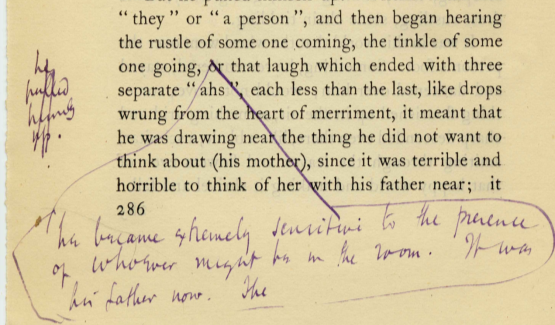
Given a second directive from the printer to cut additional material from the novel, Woolf produced the following:
Fig. 4.  Second copy of proofs with VW's inked alterations.
The HB editor accurately recopied onto the first copy of proofs the alterations Woolf had made on the second set of proofs.  No problem there, but the major deletion seems to me very significant, removing from James imagination the horror of thinking of his mother with his father near.  Readers can make of that what they will; it is not explicit elsewhere in the novel.

Friday, August 12, 2016

Computers, Wood, and Textual Studies


     Of course nothing I know about textual studies required that I learn it from computer programming or woodworking, but some of us are slow learners or learn inadvertently from seemingly unrelated events.
     In 1976 I managed to get funding from the NEH for an edition of William Makepeace Thackeray’s The History of Pendennis, an 800plus page serialized Victorian novel.  Tucked into the grant proposal was a request for funding the development of a computer collation program.  It was to be built on a prototype that had been developed by Susan Follet, a computer science MA student, under the joint direction of Edwin Ellis, professor of computer science, and Miriam Shillingsburg, professor of English.  Their work was based on earlier prototypes by Margaret S. Cabannis and Penny Gilbert.  So, in 1976, I began working with Russell Kegley, another MA student in computer science, meeting with him all day every Friday for nearly an academic year.  The end result, CASE (Computer Assisted Scholarly Editing) was a suite of nine programs that enabled collation, manipulation and merging of collation results, manipulation of diplomatic transcriptions, printing of alterations in manuscripts, textual apparatus tables, and computer typeset edited texts.  But the process, not the product, was what taught me what I had failed to learn in the normal course of training and practice in textual studies.  It is that in my line of work it was easy to fool one’s self into believing one was being careful, thorough, and conclusive.  When one has to explain to a computer (by way of a programmer who writes the explanation as instructions in a programming language so that a machine will do what is required), when I had to explain with such clarity what needed to be done so that the instructions could be written in a yes/ no, off /on, if/else form, then I discovered that in the humanities, there is normally nothing to stop us from fudging the little stuff, allowing guestimates and plausible speculations to influence our results.  When applying the unforgiving precision of computing to my process, the result of every fudge and every speculative guess was a jammed program or an endless loop.   Computer science--or at least programming--teaches attention to detail and the need to discover that which would otherwise be swept under the rug.
     The real results of that year of working with Russell Kegley was not the suite of programs, CASE, which went on to be used in preparing print editions of Thackeray, Irving, Carlyle, Dickens, Hardy, and other works, using forms of CASE developed for Univacs, Dec10, IBM mainframes, Macs, PCs, and laptops in a variety of languages from PL1, EBCDIC, Pascal, TurboPascal, and C, for various operating systems including Linux.  That was pretty satisfying, but not the main deal for me.  Nor was it the scholarly edition of Pendennis which I was able to use to support grant proposals that led to the production of nine other volumes in the Thackeray edition, which was also satisfying.  The main product of that initial grant was my comeuppance in discovering that my hatred of error and my attempts to pay attention to detail could be thwarted by a computer.  My first reaction, of course, was to blame the idiot machine that would do only what it was instructed to do.  That, of course, gave way to the realization that it was an idiot that was instructing the computer to do idiotic things.  Humbling and, eventually, enabling.  The lesson underlies the most useful thing I have done as a result of having undertaken textual studies, the writing and publishing of three editions of Scholarly Editing in the Computing Age (SECA, for short).   I have written other books, but SECA is the only one that has led perfect strangers to come up to me and tell me how helpful that book was to their own journey in textual studies.
    That brings me to woodworking, which I have taken up in a more or less serious way since I retired in 2013.   I already had a forest of hardwood trees in the steep mountains of western North Carolina, and I had acquired chainsaws, a tractor with a logging winch, a heavy duty pickup truck, and a variety of woodworking tools.  Weather causes trees to fall in the woods, where they rot, unless someone cuts them up for firewood or drags them out and takes them to a mill to be made into lumber.   That kind of work is so rough that one has to make a big mistake for it to be noticed.  If the mistake is big enough, one does not live to tell the tale.   Once the boards are cut, and air dried, and kiln dried, and planed, they can be made into floors, or tables and benches, or cabinets, or bat houses, or anything you can think of that is made of hardwoods, like maple, oak, cherry, or hickory.   My son raised my woodworking game to a new level when he bought me some new tools in exchange for giving his son a week of carpentry camp.  Table saws, radial arm saws, band saws, planers, drill presses and lathes are great for concentrating the attention of 9 and 10 year old children, but I have also found that my grandchildren’s parents and even former graduate students love carpentry camp.  Not to be outdone, another son gave me a jointer in exchange for a promise of a new desk made of hickory wood, which he and I found in the woods and dragged out together with the help of his wife and three of his children and two of my dogs--and of course the tractor and winch.
     It was in building the desk that I discovered another truth or principle important in textual studies.   Because the jointer was expensive, I had to make the desk perfect.  Time and effort would just have to be spent to make things right.  Error could not be tolerated.  Error would destroy the aim of making a product that I could be proud of and that would not embarrass my son.  The harder I worked to remove the imperfections of my work, the more obvious the little flaws became.  When one uses rough sandpaper to get rid of obvious nicks and irregularities caused by rough power tools, the more little nicks start showing up.  The finer the grain of sandpaper, the clearer and more abundant the tiny flaws become.
      My father once told me that the word “sincere” came from carpentry.   Carpenters, it seems, have from time immemorial used wax or some such substance to fill in the nicks and crannies that are too difficult to sand away.   The Latin word for wax, ceram, combined with the word for without, creates sincere, without wax.  Let me tell you.  It takes a lot of work to be sincere.
      In fact it is so hard to be sincere in carpentry that it reminds of nothing more than how hard it was to be sincere in textual studies.   To be sincere means not to pretend to anything other than what you have done.   Either you use wax or some other substance to fudge your product and hope no one notices or you work hard enough to not need wax or any other substance OR you come to the realization that you cannot produce a perfect product.
      I began by saying that some of us are slow learners.  I now realize that this certainty of imperfection was well understood in textual studies long before I came along.  And yet not all students of texts, not even scholarly editors, have leaned how to deal with the inevitability of imperfection.  The idea that one can produce an edition that will never have to be done again is a holy grail, tempting untold number of Jasons in the field.  But the old masters already knew.  They called their editions Critical Editions.  Some hopeful fool coined the word Definitive Edition, but that did not last long.  Textual scholars tend, on the whole, to be honest people--hopeful always, naive, sometimes, but mostly honest.  No one claims to have produced the perfect critical article that will end the need for new critical articles.  That would be laughable.  Critics can do seminal work, but they cannot do terminal work.  Likewise, textual critics and scholarly editors can bring high levels of sophistication and skill to their work; they can be innovative and exciting; but they cannot produce a definitive edition that will make all other editions unnecessary or passe.  That is equally laughable.
       My son’s desk is imperfect.  I told him I would build a replacement desk.  In the meantime, he put the imperfect desk in his home office.  The first person who came to his house to do business offered to buy it.  But it is not good enough.   Neither is that edition you just finished producing.  Learn to live with it.

Bichitra: The Making of a Tagore Website

Bichitra: The Making of a Tagore Website
Sukanta Chaudhuri (with others)

            There are, in the world, more native speakers of Bengali than of Russian, Japanese, German, French, or Italian.   There is only one Bengali writer who has won the Nobel Prize for Literature, but the archive of his writings is larger than Shakespeare's, Goethe's, Proust's, or Faulkner's.    His name is Rabindranath Tagore, poet, novelist, historian, dramatist, painter, sculptor, composer, educator, translator.    His archive of manuscripts and printed works, amounting to over 140,000 pages, is the first major writer's archive to be entirely (almost) digitized and posted to the Internet--"almost" because 40 rare books out of 450 books and 300 out of 3,200 journal items could not (yet) be obtained for reproduction.  The virtual archive was accomplished in two years by a team of 30 plus researchers and computer programmers funded primarily by the Indian government, which found itself justly proud of its Nobel Laureate on the occasion of his 150th birthday in 2011.
            How they did it and why you should care is the subject of a new book, Bichitra: the Making of a Tagore Website, by the project director Sukanta Chaudhuri.   Readers of Chaudhuri's book, The Metaphysics of Text, are familiar with his elegant and clear prose, his attention to detail, his self-effacing grace, and his incredible stamina.  Most of the world needs this book because we don't know Tagore well enough, we don't know Bengali, and we don't know how to build or use virtual archives.  The onus is on us but Bichitra, the book, makes it easy to find out. 
            The first step is to understand the importance and achievements of Tagore himself.  He is a recognized world figure, but few will know that his works (he wrote in both Bengali and English) exist in multiple versions.  Sometimes he turned a play into a novel or vice versa, or he incorporated poems into novels or other works.  Sometimes his works were both collected and anthologized under his supervision, for which he made changes.  Sometimes he wrote the same work (more or less) in both Bengali and English.   But more often he was discovering new things to say with his already written works--he changed his mind--or finding a better way to say what he originally thought.    The richness of Tagore's archive for the study of the genesis of thought and of literary works is unsurpassed by any writer anywhere.  That is why it is called Bichitra, the various, the curious, the bizarre. 
           Obviously a reader needs more than just this book to explain Bichitra, the website.  One needs to be able to work one's way around in the archive.   So, there are tools: search engines and a concordance engine bring Tagore's words and subjects together.  A bibliography with links to every form of each work aggregates the related materials.  A collation program identifies the variants in the different forms of each work.
            It is an archive not an edition.  At one point Chaudhuri modestly calls it a "mere archive" to explain why the site does not explain the genetic process or explicate the significance of textual variants--except for a few examples to show the potentials.  He rightly points out that would be a major project in itself.  The site enables that kind of work; it does not do it for us.    There is nothing "mere" about this archive.  For the first time, persons interested in Tagore can read any one of dozens of versions of his works, can read rare works, can read works in the context of collections of Tagore's works or as originally printed, can read the images of original publications or the transcripts made of them in order to be computer searchable.  And readers can read manuscripts of works (mostly) published, but also for versions that were never published.
            Suppose, however, you are not interested in Tagore, you can still learn much about the Bengali language and its particular difficulties for keyboards, printing presses, and software for searching and collating.  Even questions about fonts receive careful attention.  In the absence of adequate software environments for major literary virtual archives (even for Roman alphabet languages), the Bichtra project invented its own standards for imaging, for transcriptions, and for collations.  Everyone with a large text project confronts the delight and disaster of OCR (Optical Character Recognition) which even at 98% accuracy produces an average two errors per 100 characters (counting spaces) or 40 to 50 errors per page and OCR is of no use at all for manuscripts, which have to be transcribed manually.   Bichitra represents major accomplishments of interest to digital humanists everywhere--if they can just overcome their lack of interest in Tagore or Bengali.  Ignorance is a comfortably debilitating condition, bliss--sort of.
            For me the major accomplishment of the Tagore archive is the images of (almost) every version of every work.  Digital collections of transcriptions are not archives, regardless of what anyone may claim for them.  A transcription is a copy, a reset copy.  It is different from its source text in every character because it is a copy susceptible to error at every character; it is not the original, it is not the same.   Of course, a digital image is a copy also, but it is at least visually accurate.  No one says that a picture of a person is the person.  None should say that a picture of a book is the book.  But digitally, images are as close as technology can get to providing surrogates for the material originals.   Bichitra's crown jewels are its images.  No institution has all the documents; but in this website they are collected, photographed, and mounted.  That is not only great for Tagore studies, but for all aspiring digital archives.  The process, the cameras, the lighting, the negotiations for permissions to photograph, and the alternatives for storing, archiving and displaying images are all so complex that anyone wanting to create a sophisticated archive website will learn much from the Bichitra experience.   But it is so much more.  Images cannot be searched, analyzed or collated.  For these operations transcriptions are needed.  Bichitra provides them. 
             Those last three words were so easy to write.  Over 47 thousand pages of manuscript made transcription anything but easy.  The chapter on manuscript transcription is easily the longest and most interesting because it deals so openly and sensibly with an extremely complex problem.  Most readers will soon get over their unfamiliarity with the language as they get deeper and deeper into considerations of what every manuscript transcriber has experienced.   Transcription is detective work, interpretive work, philosophical work, and practical work.  Before the end of the day, decisions have to be made about how to proceed.  Tagore was a rapid writer and inexhaustible reviser.  Some of his assistants learned to emulate his hand.  Is it a nightmare or a fertile field?  Chaudhuri seems to know that it is the former but he treats it as the latter.
            Every project director and every technical officer and computer science partner on a digital archive project will benefit from reading chapters 6 through 9 in particular.  Chapters 6, 7, and 8 do not shy from technical detail but even technically challenged textual scholars should have no difficulty understanding them.  
            They recount first the task of organizing the file structures required to keep track of hundreds of thousands of individual files of transcriptions and images.   The project team devised a new content management system because there was none to hand adequate for the job. The description of Tagore’s tangled bibliography is merely prelude to describing the organizational system that brought digital order to it.  Next they tackle the job of providing indexing and search capabilities to the website. Third, they describe the construction and function of a collation program that will handle Bengali language and multiple versions.   These three back-end systems and tools represent a formidable accomplishment; given the time in which it was done it is like a miracle.  
            Chapter 9 describes the front end--the user interface design and functions.  Given the intricate and orderly content management system, display of content for the user is potentially infinitely malleable.  The achieved system is not perfect but it is more than a very good beginning.  Nevertheless, the project was launched at a significantly high plateau of achievement.
       Chapter 10 treats the entire project as a good start and addresses three areas for improvement: additions to the content; improvements of the internal synchronization of images and transcriptions, and additional analytical tools and uses for the content.   The project, thus, fulfills the expectations of modern modular project structures, rejecting the intricate monoliths of early electronic projects.  It is extendible.
      The book begins and ends with acknowledgements to those who constructed or supported the project.  It is fitting that this description of so large a project, with such high standards, should begin and end so.  It takes a village to build a digital archive.


Friday, March 25, 2016

Notes on Teaching Textual Studies


Notes on Teaching Textual Studies

 (a session at the Shakespeare Studies Assoc. New Orleans, March 2016) 
I think that one reason for this session is to prove wrong the general notion that textual study us deadly boring to students.  Our own counter myth is that the monolithic marble monument which is the one true text of Shakespeare is itself boring and off-putting, not to say frequently wrong.  Neither of these narratives strikes me as wholly true, but our focus is on the question, can textual studies energize students' understanding and enjoyment of Shakespeare's plays.   The papers presented in this seminar show that it does.  It does so by several different paths. 
1. Examining the range of variant historical texts gives students permission to question the text by showing the tenuousness of the supposedly finished text and the vulnerability of the developing text in the hands of both genius and incompetent text handlers.  Permission to question is an essential element of learning.
2.  It gives students the individual responsibility of determining the significance of the play by asking them to choose among various texts.  This aspect is enhanced by the more familiar notion that performances fill in a great deal that is not explicit in the text.  The things that went without saying must have been well understood by Shakespeare's contemporaries and therefore went without saying.  They no longer go without saying and yet must now be acted out, performed in accordance with our best informed guesses about how to make the text live.  There may be wrong answers but there may not be a single one right answer either.  The explanations one reads in the footnotes ain't necessarily so.  And yet, some erudite reasoning on recondite information found in the seminar papers prepared for this session suggests that textual variation is not just a smorgasbord of choices to be made willy nilly according to uninformed guesstimate.   Research leads to better guesses.
3.  Confronting original material texts, even if only through images on a screen, gives students a clearer sense of the passage of time and of their own precarious temporal position on the shifting sands of the English language.  Our today, like Shakespeare's, soon becomes the murky past; modernized texts don't stay modern.   Like other doses of reality, this realization could be enervating or invigorating, but it is clear from the seminar papers that the realities of textual and verbal instability are not things we need to protect our students against.  (It might be worth pointing out that instability of text preceded any of our destabilizing moves.  The illusion of textual stability is just a mark of the textual ignorance with which many students and some of our colleagues approach what they call literature and we call a text.)
4.  Awareness of textual complexities gives students a clearer sense of the relationship between the written text and the spoken word.  Particularly this struck me in the examination of 15th and 16th century printers' symbols used to mean a variety of things that, at the time, were perfectly ordinary but which now seem strange to the untrained eye.  Spelling and punctuation carry similar lessons for us.  Learning to read is a never ending but liberating process.  Dismissing material evidence that we do not understand is a stupid way to study Shakespeare--literally.  It is not the case that textual criticism is the art of detecting that which we do not understand and replacing it with something we do.  That would reflect a love of ignorance.
5.  I asked myself why it is that the students described in these papers as well as my experience of forty years dragging alternative texts into classrooms--why do students always glom onto variants in texts.   I recall one of my classes cursed by the bookstore having substituted a cheap inferior text for the one I ordered. Upon comparing a passage in his text to the one in mine, a student in the back threw his text on the floor, pointed at my copy and said, "I want that one."   Students are interested, not only for the four reasons already given, I think, but for a more profound resonance that students have with the functions of variant texts in processing and understanding words.   It is what I tried to express at excruciating length in chapter three of From Gutenberg to Google and which I called rather grandiosely Script Act Theory.   It is that in understanding any text, whether written or spoken, the words of a sentence are understood in a particular way NOT because of what they are intrinsically but by how they contrast with what they are not but could have been, given the surroundings in which they are found.  Touchdown and Spinach are both nouns and can be grammatically correctly substituted in a sample sentence, but spinach is not something that can be shouted at a football game.  Context is old hat in interpretation.  Either we use the context we know to be the operative context of the text's origination or, in literature, if we don't know that context, we sometimes make one up.  That is how John Keats's  "Oh, Attic shape" in "Ode to the Grecian Urn" can remind us of the big vase in grandma's attic.  If we get context wrong, all sorts of wonderful adventitious things can happen.  But textual studies gives us the other important contrast--that between what is said or written and that which, in the given context, could have been said or written.  If you live in a green house I know it is not white or yellow or blue.  That is how I understand green house.  I am not confused about green houses for raising plants--that is not a viable alternative for the house you live in.  If you have sullied flesh I know it is not clean or soiled or solid or sallied.  That is how I understand sullied.   Textual variants give us some of the unspoken words at least as they were understood or misunderstood by someone close to the text's origin.   And since in Shakespeare's case we frequently do not know if the original word or the replacement was correct or if the  alternative was newly intended or if it was just a new mistake, the student gets to react to the variants in a very sophisticated way, because they have, from the beginning of their language use as babies, been testing every spoken and written word against its appropriate alternatives in the contexts in which the words are encountered.  That is how they are used to finding appropriate meanings.  We almost don't have to teach this thing.  The most tricky thing to get them to acknowledge is that experiencing two or more texts of a passage side by side, holding them in comparative and contrasting contemplation, is often more satisfyingly rich than rejecting one and sticking with the single monumentally marble one.   That might not be a perform-able richness, but it does play well in the mind.
6.  The consideration of variants in Shakespeare's text does not have to be restricted to those found in early Quartos and the Folio.  Once you get on a roll with this thing, the editorial speculative conjectures through the years becomes fair game, both for joy and disdain.   But it is worth pointing out again two important matters to be considered.  First, is it okay to approach textual variation with ignorance about their origins and contexts?  If so, then perhaps it does not matter what mashup students make of the text as long as they think it is fun, like a game.  My experience makes me think students soon tire of that game because there are no consequences; there is no standard against which to measure their success or failure.  Textual awareness, I have found, involves more than the realization that there are variants.  It involves the full range of what we call textual criticism.  A little knowledge is a dangerous things, so drink deep from the fonts of information available to us, including that often neglected fact that in some cases we just cannot know.  The editors our predecessors in the production of new texts for classroom use have been limited by two factors over which they had no control.  The first is the limitation placed upon them by the print media and publishers whose eye was on the bottom line.  They had to be brief.  The second is the editor's own ignorance and misunderstandings.  Misunderstanding feels exactly like understanding until it is properly acknowledged.  Often that acknowledgement comes after publication.  So treat your classroom edition with care.  But also treat previous editor's emendations as a resource of variants that extend those in the early record.
7.   Some minor recommendations: 
a. Assigning students "tasks" might be less conducive to good work than asking them to help you explore possibilities.  Doing tasks always bored me.  The assumption is that the only thing one will find is what the teacher already knew.  Why not save time and just tell me.  But exploring and helping--who knows what we will come up with.  However, giving students free rein to make stuff up might be less interesting than giving them free rein within the strict parameters of  logic and the rules of evidence. 
b. Extrapolating from a few  examples in one area of editorial ignorance to a blanket condemnation of eclectic editing I did not find to be very convincing.  Lost and unachieved texts, created out of the surviving textual record by critical analysis does not produce correct texts, but they do create contrasts to the surviving records.  It is good to remember that the variants among historical texts resulted from speculative emendation on the part of their editors, also.   

c. We probably do not need reminding that textual studies of original texts cannot be conducted on reprints or modern editions without recourse to original texts or at least to facsimiles of them.  Every edition claiming to reproduce the text of an original edition is itself a new completely re-contextualized material object reflecting our own time.  Unfortunately, that is true of digital facsimiles as well, though I have no idea how to avoid that.  We just have a lot of explaining to do.

Sunday, April 5, 2015

Global Textual Scholarship

Global Textual Scholarship: An American View 

On March 18, 2015, at a symposium on textual studies in Japan, organized by Kiyoko Myojo and sponsored by Saitama University and Keio University, I gave the following talk.  The slides add nothing to the reading text.

                                           
            Textual scholars everywhere have some common objectives and some common obstacles.  SLIDE 2 Our objectives are to understand literature and represent it understandably to interested readers.   This means we write introductions and commentary and notes, which we think will increase another person's understanding and appreciation for the beauty or wisdom of literature.   It also means that we promote the creation of new copies of the texts of literary works.  Anyone who has compared in detail any copy of anything with its original can make a list of differences.  There are always differences.  Sometimes the differences are important.  And so we have two goals for our newly copied texts:  first, that they be accurate copies, and second, that we account for the important differences in copies before ours.  
            Common obstacles to our goals are ignorance, error, and poor judgment.  It takes uncommon skills to overcome these obstacles.   Sometimes we can only minimize the ill-effects of ignorance, error and poor judgment.  We have, however, tools that will help us.   We have investigative skills, proofreading skills, and analytical skills.   Our objectives and the skills needed to achieve them are shared by textual scholars globally.  Unfortunately, the obstacles of ignorance, error and poor judgment are also global.   
            The good side of textual studies, the side that investigates and exercises care, is not the same everywhere.  Textual scholars do not all agree about how to combat ignorance, error, and poor judgment.  They do not always agree about how to copy or edit or prepare texts for republication.  The methodsof textual scholarship have sometimes been culturally determined, such that textual scholarship, editorial principles, and interpretive criticism seem to have acquired national tendencies.   We may therefore think that there is a German way, a French way, and an Anglo-American way to conduct textual criticism.  If that is so, why should there not also be a Japanese method?
            My aim here is to suggest that the different tendencies associated with different countries are available to us all.   That is, I no longer believe that there is a method of textual criticism that is right for German literature and a different method that is right for American literature.  I do not think that there is a Western way and an Eastern way or that one is better than the other.  They may be different, but there are different things that a new edition can do.  We have choices.  Instead of associating one goal and method with a country, we can identify a number of different goals for textual scholarship, and associate with each goal a methodology that is suitable to its goal.  For that reason, I will be referring to a range of editorial goals, rather than to a range of countries in which one or another method is dominant.SUMMARY 1
            First, let me try to dissect textual scholarship in a series of steps.    SLIDE 3
1.  All textual evidence is documentary.  About literature,if one asks, "Where did that come from?" the ultimate answer is ALWAYS, "It came from a document, which may have been copied from another document."   When one has reached the earliest surviving document, one has reached the final shred of extant textual evidence.  We do not have time machines with which to ask authors in the past questions about what they are writing.   The bedrock of our work is facts.  SLIDE 4 Our facts are documentary.  Our documents are material.  Our texts are symbolic.  Textual meaning is interpretive.  Reading is interpretive.  Reading depends on skills for analyzing symbols recorded on material documents.   We are in a circle from which we cannot escape.  Most readers operate with minimal textual information; textual scholars require all the information.  SLIDE 5
2.   Therefore, the first task of textual scholarship is to find all the documents and understand the order of their descent from earliest times to now.    We begin with ignorance; we use our investigative skills, we collect documents on which are written the texts we wish to examine and edit.  We arrive at knowledge of documentary facts. Our enemies are error, fatigue, poor judgment (oh, and lack of money).   SUMMARY 2
3.  When a textual scholar has found and collected all the surviving documentary evidence, what is to be done with it?   We have reached the first point of difference among the world's textual scholars.  Instead of asking, "Which is the correct next step?"  SLIDE 6 Let us ask, "What are the possibilities?"  I think all of the possibilities I am about to list will be attractive to you, but the order of their attractiveness may vary from one person to the next.  Probably no editor will want to accomplish all of them--too much work.  SLIDE 7
a. Digitize images of all the documents.   That will make it possible, from anywhere in the world, to see any document side-by-side with any other document without traveling from Tokyo to Marburg and New York.  SLIDE 8
b.  Prepare a table of variants to show how all the documentary texts differ from one another.  SLIDE 9
c.  Write a textual history that explains the relationships among the variant documents and explains why we should care--why it is important to know.  SLIDE 10
d.  Transcribe at least one of the documents so that the variants list can be more easily used.  Or transcribe all the documents so that readers can select and read any one.  Transcribing all the documents will also make machine collation possible. SLIDE 11
e.  Edit one of the transcriptions to correct obvious errors.  This will preserve the text as a historical documentary text but will help readers avoid the distractions caused by scribal or compositorial errors.
So far no controversies.  SLIDE 12  I have described what Historical/Critical editions accomplish.  It is also what Anglo-American editors do before they start editing the work.  Some editors think that this is the point at which Anglo-American editors start ruining their work.   We will discuss that in a minute.  What we have so far: digital images, transcriptions, lists of variants, and the textual scholar's explanation of the textual history, the relationships among the documents, and an indication of why all of that is important.   That is basic work.  Every textual scholar should do it. SUMMARY 3
            But there are more possibilities. SLIDE 13  The truth is that what we have done so far replicates and explains the past.  It does not do anything about it.  Our scholarship shows who did well and who did poorly, but so far we have worked only with documents.  We have not addressed the question, how do  literary documents become literary works.  Most readers who love literature, who love to read, who are very good readers, do not care about documents.  They care about works.  Documents are not works.  They are the evidence for works.  A literary document becomes a work when a reader reads it, performs it.  A document is a material object; a work is a mind object--like mathematical abstractions, or unicorns, or thoughts.   Readers create mind objects from the evidence found in documents.  When the whole history of documents is flawed in the normal ways that copies are flawed, the editor replicates the flaws and the reader has to read through them or around them.  Perhaps the editor can do something to make a new document that is better evidence of the literary work than are any of the historical documents.  That idea is the basis for Anglo-American editing.  SLIDE 14  This gives textual scholars a new additional possible task: Do something with the facts. 
f.  Use analytical skills to identify the author's work and the work of those whose help was compatible with the author's purposes.  Then, edit an eclectic text that reflects those selected aspects of texts found in various documents.   For example, eliminate the homogenizing work of standardization and or eliminate censorship and compositors' mis-readings that marred the historical documentary texts.  Always provide a list of your emendations.  SLIDE 15
g.  Avoid editing altogether and, instead, write analytical essays about the creative development of texts from the way author's used their source and the way they revised from the earliest drafts though the most revised printed text.  And write about the interpretive consequences of variant texts in process.
SUMMARY 4
I have tried to list these possibilities in a progressive order.  SLIDE 16  With the exception of A (digitization of images),goals B, C, and D (variants lists, textual histories, and transcriptions)  seem necessary to finish before the other goals can be attempted.   The reason I put A (digitization) first is that, now in the digital age, it seems to me that it SHOULD be first.  (If you ask me, I'll tell you why later.)  In this progressive list of possibilities, I have avoided the question, "Which is the right way to conduct textual scholarship?"   Instead, the list supports a wish: "Yes, if there were time and money, we would like to see all of them."   There are two reason why there IS in fact both time and money.  That has not always been the case.  Editors have had to choose among these goals because editors have not had the time or the money to accomplish all of them,and because the print medium has placed upon editors certain requirements and limitation. One resulting tendency is that editors have often defended their own choice of goals and methods as the best solution for all editors. SUMMARY 5
            The result has been that Historical/Critical editing, often associated with Germany, but seen often in other European textual traditions, has focused on B, C, and E--making B (a textual apparatus of variants), C (textual histories), and D or E(a transcribed text, possibly with errors corrected) the end-point for scholarly editing.  There are many reasons to stop there, though most of these reasons have to do with print technology and no longer hold true in the digital age.  For many Historical/Critical editors, the scholarly edition produces a one-stop, printed source of historical information that can be used as the basis for other purposes, such as editing student editions or conducting genetic studies.
            Anglo-American editorial traditions, on the other hand, tended to focus attention on F (extracting an eclectic text that reflects the author's purposes better than did any historical text).   Anglo-American editors did all the work of B, C, and E, but they never thought they had the money to print and publish these steps in the process.  What the American granting agencies tended to fund were editions that fulfilled, as best that scholarly analytical skill could determine, the full fruition of Anglo-American authorship.  That required eclectic texts.
            Neither of these objectives of textual scholarship exhaust what students of literature want to know about documents and texts.   Critique génétique reflects investigative urges that are not fulfilled by collections of historical documentary facts and are not content with anyone else's notion of what the text should have been.   Instead, geneticists want to investigate the processes of textual development.  These include the processes of creativity, of selection, of corruption, of intervention, and of critical consumption.    To conduct such studies items B, C, D, and E are helpful, but in themselves areincomplete.  To a geneticist, F (the eclectic edition) was too narrowly focused on one way to distinguish right from wrong texts; geneticists were interested in all texts.SUMMARY 6
            Eclectic editions flourished in America more than elsewhere.   I will argue that, when the eclectic edition has been properly understood, it will be seen to have a legitimate place in the range of textual scholarship. We might even all wish to seeeclectic editions supported.   Textual scholarship is so complex and diverse thatwe might think there is enough work to do to establish the historical record and not enough time to try to fix the errors of history.  We say we do not have enough time or money.    But that is no longer true for two reasons.  SLIDE 17
            The first reason is that in the digital age the work of one editor or small group of editors can serve as the foundation for another or many other editors.  This was not true in the print world.  Print projects had to be defined from beginning to end and completed before publication.  Once published in print, a new project that wished to build on the accomplishments of the previous project had to begin production processes from the ground up.   Not so with digital projects.  If one starts a digital project by creating digital images of all the documents, one has a resource that will serve all subsequent textual projects.  That is true even if a new textual scholar finds a reason to go see the originals themselves.  I hope there will always be reasons and means to see original documents.  As substitutes for originals, however, digital images are as close as can be produced.   The next steps--transcriptions and collations and the preparations of textual histories--focus on the documentary record.  These steps establish the facts of the material and symbolic evidence.   Of course, transcribing texts is only as good as the proofreading;  collation tables are only as good as the design of the apparatus that displays them; and textual histories are only as good as the analytical skills of the textual historian.  But in all these tasks, it is the record of facts that counts.    Placed in a virtual archive--that is, a digital archive--this part of textual scholarship offers a valuable resource for further work in the ultimate task of understanding literature and representing it understandably to readers.
            The second reason that we now have sufficient time and money do conduct all the work of textual scholarship is dependent on the first.   Whereas in the print era, a project need to be planned and completed before publication, in the digital age, a project does not need to be planned from beginning to end and completed before being "published"--or rather before being launched on the Internet.   If we start with the foundation of a virtual archive, then a generation or more of other textual scholars can use the images, transcriptions, collations, and textual histories in order to generate additional scholarship and criticism.   The last time I was in Japan I talked about HRIT (Humanities Research Infrastructure and Tools) as one environment designed to host a virtual archive and to encourage and host scholarly contributions to the textual scholarship needed to transform an archive into representations of literature for interested readers.  There are other platforms that are now even more advanced than the one I envisioned.  The most interesting of them to me is AUST-ESE developed in Australia, originally for Australian Electronic Scholarly Editing, but available for use with other literatures--at least other literature using the Roman alphabet.SUMMARY 7
            Time and money need no longer be measured by how much time or money an individualeditor or a single project has available in the foreseeable future.  Time and money now extends beyond our vision for virtual archives that serve as a the basis for further editions, textual scholarship, and interpretive criticism.  Eventually, our project will become their project and may, someday be finished.  SLIDE 18
It will have images of all the historical documents.
Transcriptions of all the historical documents.
A collation of variants among the historical documents.
An explanation of the transmission of texts from document to document.
An explanation of the nature of textual variation:   who made the changes? why they made the changes?  which changes were accidental and which were on purpose? 
Commentary and notes on the text. SUMMARY 8
            I'll end with a short accountof why I believe in the value of eclectic editions.  I was trained to believe that eclectic editions could be definitive and stand on their own to represent both the history and the achievement of textual art.  They are NOT definitive.  But they can be valuable.I understand eclectic editions now as contributions to the overall achievement of textual scholarship.
            The English author, William Makepeace Thackeray, worked for ten years as a journalist and writer of travel books before his first great novel, Vanity Fair, was published in 1847-1848.  During that time he worked with many publishers and proofread his work as typeset by many compositors.  Thackeray knew the printing and publishing trades because he was friends with his publishers and familiar with the printing offices.   That is one part of Thackeray.
       Thackeray was also a smooth stylist, a perfect speller, and a rapid writer, whose punctuation is barely adequate for publication.  Anyone looking at Thackeray's manuscripts knows they cannot be published as written with any hope that readers will think well of the printer.   But Thackeray did punctuate his manuscripts according to the rules he learned in school.   These rules were rhetorical, designed to help readers by suggesting pauses of different lengths as one reads aloud.   The problem is that Thackeray did not always put all the quotation marks in, sometimes his periods look like dashes, and sometimes his ear for the sound of the sentence did not match what was conventionally expected.  Hence, his manuscript punctuation needed some fixing up.
            Compositors in England at the mid-19th-century were paid by the amount of type that they set.  They were required to correct errors for no pay at all.  And they were given Thackeray's manuscripts exactly as he wrote them.  Compositors were skilled workmen.  They worked as fast as they could.  They fixed Thackeray's punctuation by following their own rules.  Those rules were grammatical rules designed to help readers by indicating the grammatical structure of sentences.  The quotation marks and periods are in place.   But the pauses of different lengths which Thackeray had indicatedwere mostly changed to grammatical indications of sentence structure.   The result was that the printed texts have far more punctuation than was needed.    SLIDE 19
            The eclectic text I wanted had Thackeray's manuscript punctuation, cleaned up somewhat, but not to the extent imposed by compositors.   It also had the revisions that Thackeray made in proofs and which showed up only in the printed texts.    The eclectic text does not substitute for, nor replace, the historical documents.  Instead it does something that what no historical document does, which is to representThackeray's writing as it would have been had the compositors been less hurried and more in tune with Thackeray's ear for style.
            As textual scholars, we share many tasks, we share many standards.  But we do not all want to accomplish the same goal in editing.  And no matter how you edit, there is always something your edition cannot do.  So, define your goal and explain your method.  If your work is accurate and your method is clear, then you have a right to do what you did.  But please do not pretend that you have had the last word.  All the editions that went before you, and all the editions that will come after you, have some appeal that yours does not have.  And yours will have an appeal that the others do not have--if you are accurate and clear.SUMMARY 9